The store will not work correctly when cookies are disabled.
Cookie Preferences
We use cookies and similar technologies to enhance your experience and ensure smooth order processing and to improve our website by analysing visitor behaviour or personalise content and show relevant offers.
Essential cookies are required for the site to function and cannot be disabled. By clicking "Accept" you agree to all cookies, including analytics and marketing. To decline non-essential cookies, click "Decline".
How to Measure a Splashback (The Ultimate Step-by-Step Guide for a Perfect Fit)
Knowing how to measure a splashback correctly is the most important step before ordering acrylic, glass or aluminium splashback panels. Whether you're renovating a kitchen or adding a modern feature behind the hob, accurate measurements ensure your splashback fits perfectly, lines up with your sockets, and installs without gaps or trimming.
This complete guide walks you through every measurement you need, from standard rectangular panels to more complex layouts with cut-outs, corners and extractor hoods. No previous DIY experience is required, just a tape measure and a few minutes.
Why Getting Your Splashback Measurements Right Matters
Ordering a splashback cut to the wrong size can result in:
Visible gaps
Edges that don't align with cabinets
Socket plates that won't sit flat
A panel that simply won't fit the space
Most splashbacks are custom-cut, so mistakes can be costly. Following this guide will help you get measurements accurate to the millimetre, ensuring a smooth installation and a professional finish.
What You Need Before You Start
To measure a splashback accurately, gather:
Tape measure (preferably a metal one for accuracy)
Pencil and notepad
A simple sketch of your splashback area to note measurements on
Step 1: Inspect the Splashback Area
Before taking measurements, look closely at the space:
Check for:
Uneven walls (common in older homes)
Worktops that slope or bow
Tiles with protruding edges
Sockets or controls that interrupt the space
Cooker hoods at different depths
Wall units that are slightly off level
Because very few walls are perfectly straight, it’s essential to measure in multiple places.
Step 2: Measure the Width
Width is one of the most important measurements when ordering a splashback.
How to measure the width:
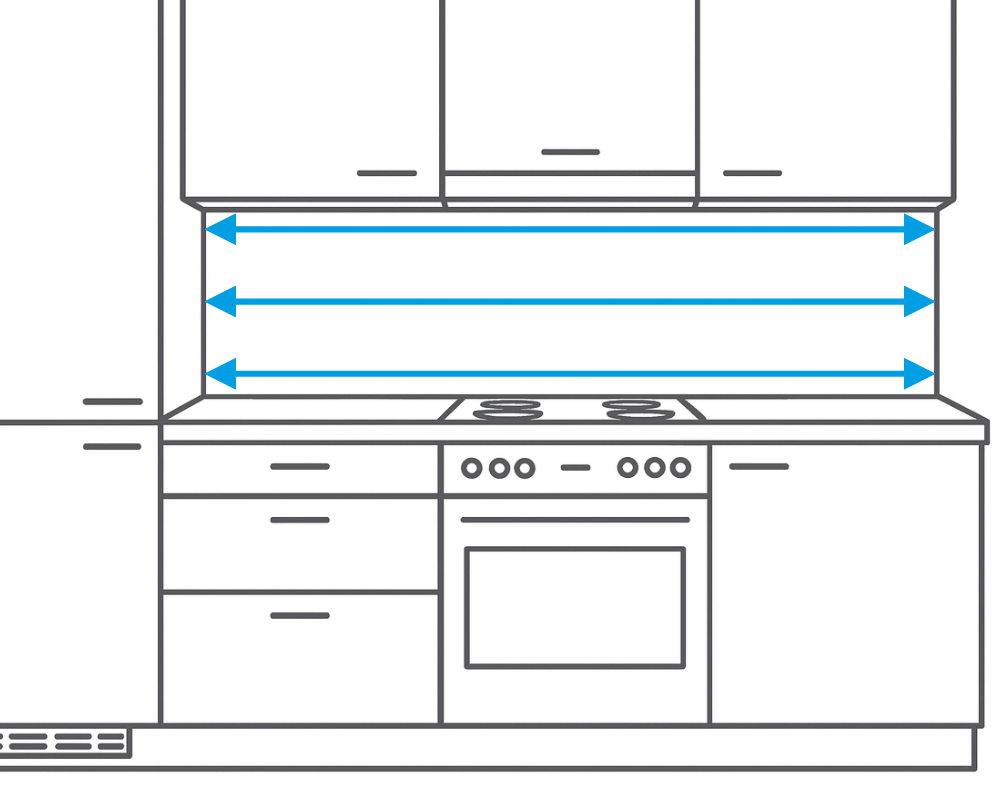
Measure the full width along the worktop where the splashback will sit.
Measure again halfway up the wall.
Take an extra measurement just below the cabinets.
Use the smallest measurement — this prevents tight spots caused by uneven walls.
Important: If your wall bows inwards, the smallest measurement ensures the splashback fits into the narrowest part.
Measure in three places and take the smallest measurement
Step 3: Measure the Height
Next, measure the height of the splashback area.
How to measure splashback height:
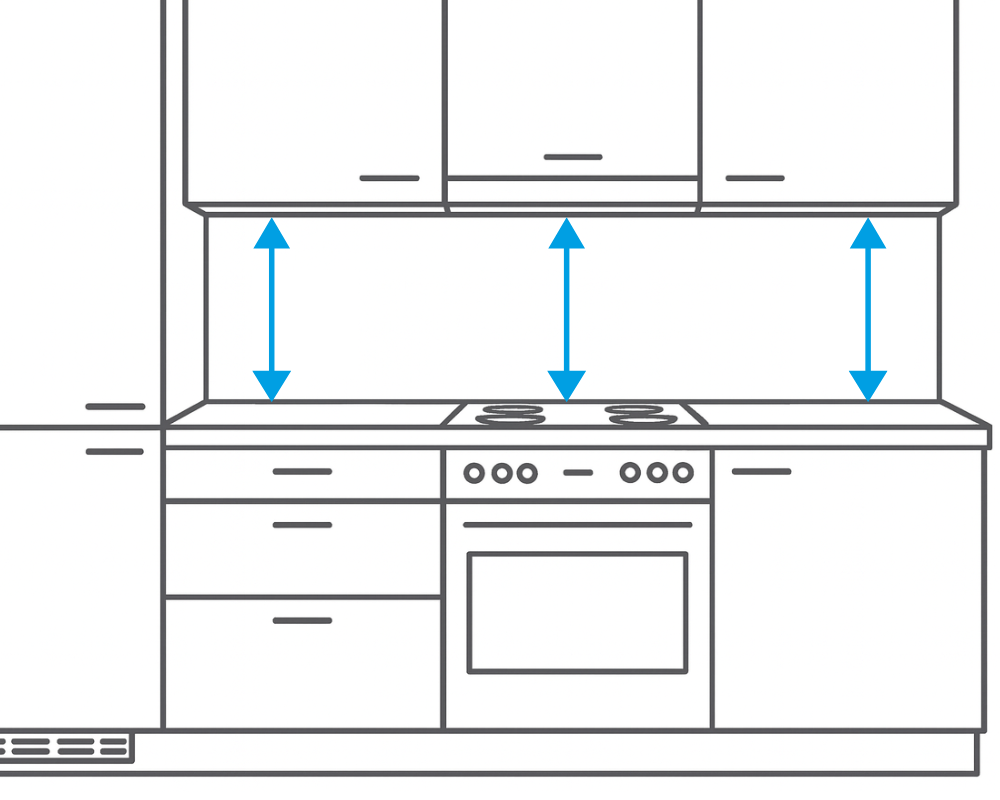
Measure from the worktop to the underside of the wall units
If there are no wall units, measure to your desired height (e.g., 600mm or full height to extractor)
Measure at two or three points
Use the smallest number
Measure in three places and take the smallest measurement
Step 4: Expansion allowance
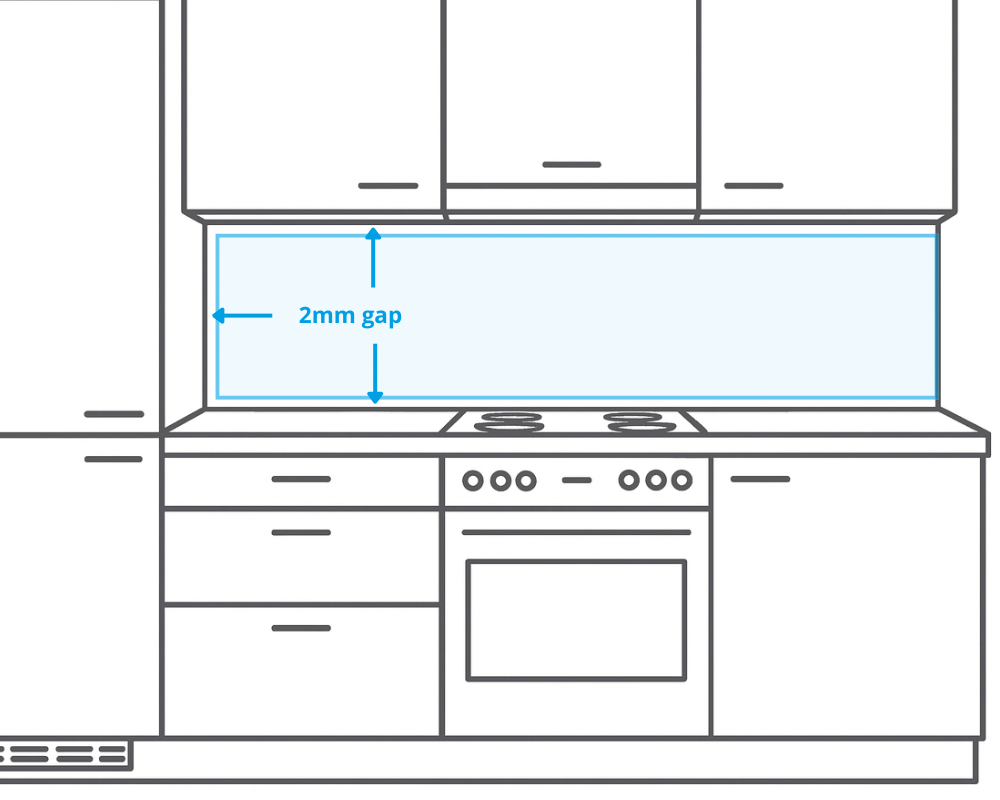
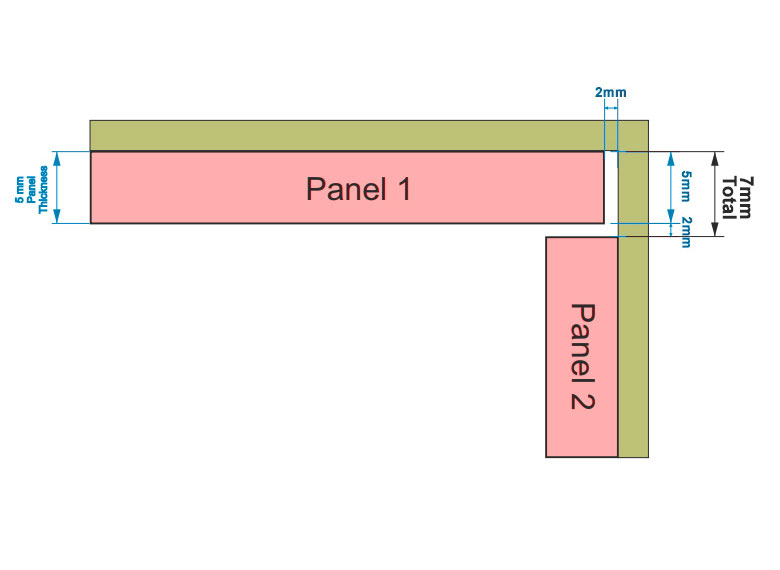
Minus 2mm from every side of the splashback that meets a wall or object.
Why is this important?
When measuring, it’s important to allow for natural expansion. Splashbacks, worktops and cupboards can all expand in heat. If a splashback is fitted too tightly, without any room to expand, it can press against surrounding surfaces and eventually crack.
To prevent this, we advise leaving a 2mm expansion gap on every edge where the splashback meets a wall, cabinet, or any other fixed object. This small allowance ensures the panel can expand safely and maintain a perfect fit over time.
Minus 2mm where the splashback meets a wall or object
Step 5: Measuring Around Sockets, Switches & Obstacles
Most kitchens have multiple sockets along the worktop, so accurate cut-out measurements are essential.
You need to record:
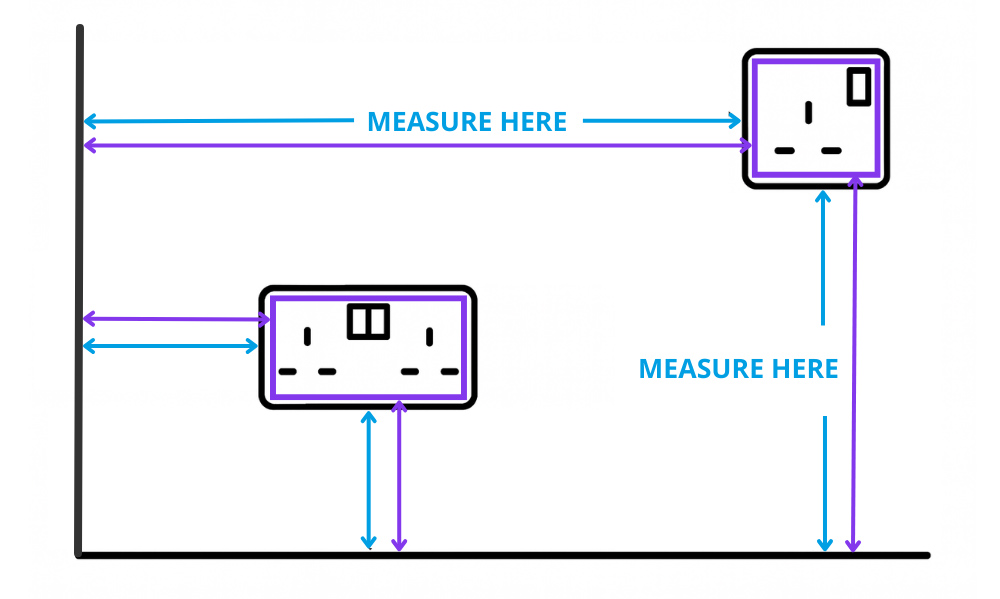
Height and width of the socket - minus 10mm (a standard double is 145 x 85mm, standard single is 85 x 85mm, so your socket size would be 135 x 75mm or 75mm x 75mm)
Horizontal distance from the left wall or edge of the splashback (Offset Left) - plus 5mm
Vertical distance from the worktop to the bottom of the socket (Offset Bottom) - plus 5mm
FINAL MEASUREMENT: Minus 10mm from socket size and add 5mm to offset left and bottom to make sure the splashback sits behind the socket faceplate.
Repeat for:
Double sockets
Fused spurs
Cooker switches
Isolation switches
Ethernet or USB ports
Control boxes (boilers, hobs, etc.)
Step 6: Measuring a Splashback Behind a Hob or Extractor
Whether you have a gas hob, induction hob, or an angled extractor hood, the process is similar.
How to measure this area:
Measure from the hob surface to the bottom of the extractor
If installing a full-height splashback, measure from the worktop to the extractor
Take two or three measurements and choose the smallest
If the extractor widens at the bottom, measure the narrowest point
Step 7: Measuring L-Shaped, U-Shaped, or Multi-Section Splashbacks
If your splashback needs to cover more than one wall or an area with corners, divide it into sections.
How to measure complex splashbacks:
Break the area into simple rectangles
Measure each rectangle separately
Mark where the joins or corners meet
Note all socket positions relative to each individual section
You do not need to draw a perfect diagram — just a clear sketch. We have several splashback templates you can download and print for some simple shapes.
How to Measure Splashbacks for Internal Corners (Butt Joints & Overlap Joints)
Measuring an internal corner can look complicated, but once you understand how each joint works, the process becomes very straightforward. Internal corners are fitted using either an overlap joint or a butt joint, and the measurements differ slightly depending on which method you use.
Below is a simple explanation of both methods — including exactly what you need to deduct for a perfect, tight-fitting corner.
Option 1: Overlap Joint (Panel Over Panel)
An overlap joint is where one splashback panel slightly overlaps the edge of the next panel. This method is ideal if you want to reduce visible silicone lines and create a cleaner internal corner.
How to Measure for an Overlap Joint
Measure the full width of your first panel section.
Deduct a 2mm expansion gap (for acrylic or composite panels).
Now deduct:
The full thickness of the second panel, plus
An additional 2mm to ensure the overlap sits comfortably and doesn't force the panels apart.
This gives you the correct finished width for the first panel, so it sits neatly behind the second.
Why choose this method?
Minimal silicone needed
Cleaner corner appearance
Great for modern, seamless installations
Option 2: Butt Joint (Panels Meet in the Corner)
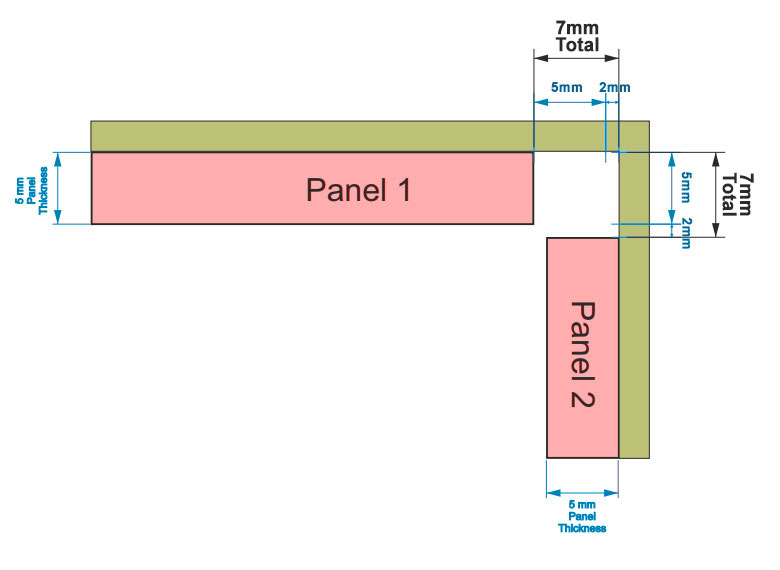
A butt joint is where both panels meet flush in the corner — edge to edge. This method is commonly used with corner trims and gives more flexibility during installation.
How to Measure for a Butt Joint
For each panel:
Start with your full panel width as measured.
Deduct the panel thickness from the edge that will sit in the corner.
Allow a 2mm expansion gap.
Repeat the same calculation for the second panel that meets it in the corner.
This ensures both panels sit comfortably within the corner without forcing or bowing.
Why choose this method?
Works perfectly with corner trim profiles
Allows easier adjustment when fitting
Silicone can be used to create a smooth, flexible join
Finally: Double-Check All Measurements
Before placing your order, check:
Have you used mm, not cm?
Have you recorded the smallest width and height?
Have you allowed for expansion (if required)?
Have you added 5mm overlap to socket measurements?
Are your cut-out positions clearly marked?
Frequently Asked Questions
How do you measure a splashback accurately?
Measure width and height in several places in millimetres, use the smallest measurement, and record socket positions carefully. Repeat and check your measurements.
What is the standard height for a kitchen splashback?
Most splashbacks are 600mm high, but you can measure from worktop to cabinets or choose a custom height.
How much clearance do you need for sockets?
Add 5mm extra around each socket cut-out so the splashback sits neatly behind the faceplate.
Do I need to account for expansion?
Splashbacks require a 2mm expansion gap.
Can I measure my own splashback or do I need a professional?
Most people can measure their own splashback using a tape measure. Only highly complex shapes may benefit from templating.
Final Checklist: Your Splashback Measurement Summary
Measure width at several points → use smallest
Measure height at several points → use smallest
Reduce by 2mm for expansion
Measure all socket positions and sizes
Add 5mm overlap for socket cut-outs
Sketch each section clearly
Double-check everything in millimetres
With these steps, you'll be able to order a splashback that fits perfectly the first time.
Ready to Buy Your Splashback?
We have over 70 styles and colours to choose from. Whether you want a glossy acrylic splashback, a luxury glass one or a contemporary brushed look we can help.
Albeit that I have had a satisfactory outcome with my sample order problem, I can only really give a 4 star rating. This is due to samples not being delivered and a delay with dealing with this problem. However, when my issue started to be addressed the customer service was excellent with good detailed communication and a full refund. This has restored my faith with Cut My. Therefore, any future projects I undertake, I will again look at Cut My to supply materials for these projects. I will also give Jamie a mention from the customer service team who was very understanding and professional when dealing with this.
Simon,
15 hours ago
Verified
Very well then.
Cutmy.co.uk have requested I leave a review. I see no reason not to. I received the wood I ordered in the shape, size and time frame I was promised. It was for the price agreed by both parties.
I bare neither grudge nor affection towards this company. I have given them 5 stars because they have provided a fair service and I do not wish them to be algorithmically punished.
'We must love one another or die'
Jonathan Gillam,
15 hours ago
Verified
Good product
Good product . Helpful communication.
Mr Morris,
17 hours ago
Verified
first class product
first class product, first class service, delivered fast
Charles,
17 hours ago
Verified
Parcel well.packaged so no damage
Parcel well.packaged so no damage
Delivered in a good time scale . Very pleased with the final project on completion.
Alan Hingley,
19 hours ago
Verified
Everything I could possibly want
The board and fixings were exactly as described, allowed me to do a good job (I got compliments on the work) at a sensible price.
Delivery was good, and I was impressed by the packaging, lots of space around the edges so abuse of the package did not reach the board.
I will certainly use again if I need another board.
ian stimson,
23 hours ago
Verified
Easy to order on line
Easy to order on line, with excellent guidance to choose the right wood for my purposes. Very fast delivery and helpful driver.
RubyRed,
1 day ago
Verified
Polycarbonate greenhouse glazing…
The polycarbonate greenhouse glazing was very well packed and delivered safely. It was easy to fit and so much clearer and safer than the old horticultural glass. It was more expensive, but hopefully I wont need to keep fitting new glass after every storm!
Nicholas Taylor,
1 day ago
Verified
Fast and efficient service.
So easy to order exactly the size you want so there is no waste. Good quality material and quick delivery.
Çarole Berthiaume,
1 day ago
Verified
Great products & efficient service
Have ordered three times with Cutmy now & each time a smooth transaction from beginning to end. So good that I can get what I want when I need it rather than fill my small shed with pieces of wood 'just in case'! Fair price & quick delivery - thanks!
Jon Brown,
1 day ago
Verified
Excellent
Excellent, quick turnaround and exactly what I ordered. Well done Cut My.
GSJ,
1 day ago
Verified
Website was easy to use and good…
Website was easy to use and good communication, would use again.
Graham,
1 day ago
Verified
OSB Board for shed roof.
Excellent service. Needed some wood to replace small shed roof. This was perfect as it was cut to size and delivered the next day. Especially easy as I can’t lift very well. Delivery driver even put it inside the door me. Very happy and will definitely use again.
Christine Cridland,
1 day ago
Verified
Great value
Great value, quality and incredibly quick turn around.
Madeleine Brolly,
1 day ago
Verified
Does exactly as we wanted.
Does exactly as we wanted.
Edwin EYRE,
1 day ago
Verified
Reliable
Ordered, delivered the next day.
Well packed and cut exactly to my requirements.
Brilliant
Trevor Pembroke,
1 day ago
Verified
I wish I'd known about this place…
I wish I'd known about this place sooner! Does exactly what you need.
Rhiannon R,
1 day ago
Verified
Great service fast delivery.
Great service fast delivery.
Mark Barr,
1 day ago
Verified
All good
All good, great service
Colette Sherratt,
1 day ago
Verified
Made our veneered sheets to perfection
Made our veneered sheets to perfect size the edges perfect and packaging and delivery service was perfect, we did out 6 or so items have 1 with an imperfection but they dealt with it so efficiently I cannot complain. So all I can say is I’ll be using them again
Leigh Eades,
1 day ago
Verified
Fast delivery
Fast delivery; well packed . The piece was exactly the size I ordered; Happy days !!
Douglas Juhlin,
1 day ago
super easy to use and additional extras…
super easy to use and additional extras available.
I ordered a clear plastic sheet to top a dressing table. I expected it would take a week, line up in schedule, pick and pack etc but it turned up in two working days!
Well packed; shipping was not excessive for 1500mm long sheet.
When using the site they have numerous options of material & thicknesses to cut - plus you can add in rounded corners and cut outs. Definitely a site I will be coming back to for future projects
JL,
1 day ago
Verified
Delivered in good time and exactly what…
Delivered in good time and exactly what I wanted
Janet ROWEN,
1 day ago
Verified
Quick Efficient Delivery
Quick Efficient Delivery, Plinth Replacement Match Original Plinth Exactly
Ian Walker,
1 day ago
Verified
First Class
Great choice of products. Straight forward ordering system, with a very helpful and accurate template for radius corners. Sensible prices. Communication from the company first class. Staff were very pleasant and efficient when I needed to contact them. The shelf, for my motorhome, was absolutely spot on to the dimensions I had provided. It was packaged well. The quality was superb too. A very happy customer with no hesitation to recommend
Rach,
1 day ago
Verified
Easy ventilation for 3D printers
Wanting a way of effectively ventilating the fumes from my 3D printers, I came across the CutMy advert for window covers for air conditioning. This seemed a really good idea that I had not seen before; a few measurements later and the clear acrylic sheet arrived exactly as specified. I printed a hose adaptor to fit the ventilation hole and affixed the Velcro. Everything was quick, easy and accurate, at a reasonable cost.
Eddie,
1 day ago
Verified
Brilliant service
So easy to order from the website. Cut exactly to spec. Saved us a fortune by being able to do this ourselves. Fast delivery. Totally recommended.
Michelle,
1 day ago
Verified
Quick, precise, convenient.
Quick, precise, convenient.
Cutmy solved a very basic issue with ease and speed . They sent the perfectly cut mdfs in a matter of days. I definitely recommend them.
Ozgur Taparli,
2 days ago
Verified
Quick very simple ordering process
Quick very simple ordering process - I ordered 3 perfectly sized oval pieces so easily and they arrived well packaged really quickly
Mrs Lucy Crawford,
2 days ago
Verified
made to the exact specifications I…
made to the exact specifications I needed, I would definitely recommend using these guys (It was for a roaming solar panel on my boat)
Ben Summerhayes ninoff.com,
2 days ago
Verified
Great service
Perfect, thanks! Very quick delivery and accurate measurements. Love the web interface.
S M,
2 days ago
Verified
Perfect fit quality items.
Ordered 3mm as replacements for single glazed shed windows.
Used previous windows measurements as a template for the new ones.
There is a bit of flex on the plastic; might order another 3mm and place on top.
CC,
2 days ago
Verified
Good delivery ,size perfect for me,
Good delivery ,size perfect for me,
Mr Philip Barker,
2 days ago
Verified
Issue resolved quickly
The item arrived damaged, but was replaced quickly with no hassle.
Draw_n,
2 days ago
Verified
shaker style panel
I wanted to create a panel for unused door, the website was very helpful with the visualizer and the panel pieces came well packaged with no blemishes. The primer option was worth the extra, saved both time and achieving a smooth flat finish. Just remember 1500mm is the max height, so longer lengths are cut as 2 equals to achieve required length! The cutting to required was spot on and came together seamlessly!
Harry,
2 days ago
Verified
Very happy
Very happy, would recommend
Scott-1882,
2 days ago
Verified
Very Good Service.
I was very pleased with the cut my service. I had my order very quickly within 4 days. The quality of the wood was exceptional I ordered 4 pieces and they were all very square and were all bang on the sizes I ordered. The packaging of the wood I was really happy with they were all wrapped in a cling film wth every corner of the pieces of wood had extra padding on them and none of the wood was damaged in any way. I would have no problems in recommending cut my to anyone as the service is top notch.
Mr Cowie,
2 days ago
Verified
you supplied a 1 piece order and it was…
you supplied a 1 piece order and it was delivered very quickly.
thank you.
Douglas Dunwoody,
2 days ago
Verified
Only needed a new top for the bird…
Only needed a new top for the bird feeder!
Quite expensive for a very small piece, but I get that....it's not only about the cost of the wood!
Anyway, cut to the mm and arrived safely packed. Treated snd installed. Happy birds :)
customer,
2 days ago
Verified
We're just so pleased with this service.
We're just so pleased with out acrylic patio table top cover. The table went over in the wind and the original glass top smashed in to thousands of pieces, which we didn't want to happen again. Following the simple website and measuring carefully we've got the perfect round cover with the umbrella hole cut in the middle, brilliant.
Carolyn Pitt Roche,
2 days ago
Verified
Easy ordering experience and swift…
Easy ordering experience and swift delivery. Accurate cut. Very pleased
Derek Durst,
2 days ago
Verified
Perfect.
Perfect.Ordering, fit, finish, dispatch, delivery, all good. 100% recommend.
Rachel Fox,
2 days ago
Verified
Great service and very accurate…
Great service and very accurate cutting, fast delivery
Duncan Campbell,
2 days ago
Verified
Good products and customer service
I've had a few compliments about my custom-cut perspex glass like table top, it looks great and honestly it's hard to tell it's not glass (unless you touch it!). Good customer service and competitive prices. For transparency, there was an issue with an item upon delivery but their customer service was helpful and promptly arranged a replacement so I have no complaints
Aurora,
2 days ago
Verified
Gallery shelf
Ordered a custom gallery shelf in threeparts.it arrived within a couple of days, well packed and cheaper than I could have done myself from a large sheet of MDF. Easy to put up and has finished my T&G wall perfectly. very happy
Peter Scott,
2 days ago
Verified
This is our 2nd order from this…
This is our 2nd order from this company. I ordered a clear acrylic sheet to put on top of our wooden dining table. Great service from start to finish. Highly recommended Thank you
Mr & Mrs Nagha,
2 days ago
Verified
Top quality product and packaging
I would highly recommend this company Cut My to anyone looking for bespoke made to measure shelving. The shelves I received were exactly to specification ordered and were of very good quality.
Even the packaging was faultless, it was extremely sturdy packaging used with product delivered in excellent condition. Cannot recommend enough!
Emma,
2 days ago
Verified
Cut to exact measures and arrived…
Cut to exact measures and arrived saftely with no damages
GAMINI JAYASURIYA,
2 days ago
Verified
Needed to get our order fast as limited…
Needed to get our order fast as limited availability for delivery on site. Customer Services went over and above to make sure that they met our requirements. Super fast delivery product received perfect as ordered. Highly recommend
Gayle Sharples,
2 days ago
Verified
Excellent service and well packed
Excellent service and well packed
Mr Rogers,
2 days ago
Verified
Great alternative to tiles
Great alternative to tiles. They sent samples out for cheap which then allowed me to confirm my choice which then arrived quickly and well packaged.
Alana Graham,
2 days ago
Verified
Very easy to order
Very easy to order, my order was cut to my specifications perfectly. Arrived quickly and was then an easy project to finish
Jennifer Fura,
2 days ago
Verified
A very useful service
A very useful service when your own ability to cut or collect large sheets material is limited. Turn round and delivery was fast. The qulaity of the materials is also very high
M Pollard,
2 days ago
Verified
Order received quickly and accurately.
Order received quickly and accurately.
Philip Bailey,
2 days ago
Verified
Excellent service
Excellent service, just put in your measurements, add the extras and it arrives within 48hrs. All pre cut to fit your space. Quick delivery, very easy install. Highly recommended.
Dear Mr Riley,
3 days ago
Verified
Simple and easy
Simple and easy
customer,
3 days ago
Verified
Excellent Service
Excellent service. Came exactly as ordered and in a timely fashion. Thank you
Al,
3 days ago
Verified
Fast, reliable and reasonably priced.
Used CutMy a few times now..... As the amatuer hobbyist, I have now officially given up buying sheet ply or MDF, and trying to cut it myself. That's all okay when building small when the chop saw will suffice, but anything beyond 600mm is just not worth the aggravation.
I found "Cut my" to be reasonably priced, especially when considering the amount of time, swearing and mis-cuts that would ensue otherwise. It can add up with lots of smallish pieces hitting the minimum, but the larger panels are definitely good value.
I have had zero issues with lead time, quality or edge quality and the measurements have been millimetre perfect. ...and I have put that to the TEST with some odd sized cuts, circular cut-outs.... the lot.
....I have not had any cause for complaints.
Contacted customer service once when I messed up with sheet thicknesses... and they were there instantly on chat; problem resolved.
Fast, reliable and reasonably priced.
I would highly recommend them.
GWK,
3 days ago
Verified
Perfect Perspex window screen
Perfect Perspex window screen for the portable air conditioner hose. Hole cut in just the right place and it all fits perfectly and works like a dream! Thank u
Jennifer Seaward,
3 days ago
Verified
Perfect cut to measure worktops and…
Perfect cut to measure worktops and panelling.
Great Service and quality and highly recommend. Good job.
Jonny Chat,
3 days ago
Verified
True to size
True to size. Great quality
Catherine Bell,
3 days ago
Verified
Excellent product and order delivery
Excellent product and order delivery
Michael Hutchison,
3 days ago
Very quick turn round
Very quick turn round.
Needed two small pieces of Marine plywood.
Item sent next day and arrived a day later. Would definitely recommend.
ian leedham,
3 days ago
Verified
ease of choosing
ease of choosing, price was good packaging was good arrival was as said. Will use them in the future
Peter,
3 days ago
Verified
Top quality speedy service as usual
Top quality speedy service as usual
Dan Ogden,
3 days ago
Verified
Cut exactly to size and quick delivery
Cut exactly to size and quick delivery. Good product
jean murphy,
3 days ago
Verified
Easy to order and came on time
Easy to order and came on time. Perspex sheet is exactly what we wanted and finished properly.
customer,
3 days ago
Verified
Easy to order
Easy to order, quality product and quickly delivered. A plan of which piece goes where may be useful
Jellybean,
3 days ago
Verified
Excellent product well wrapped when…
Excellent product well wrapped when delivered and very promp
David Byrne,
3 days ago
Verified
2 50mm x 50mm 3mm thick Perspex windows…
2 50mm x 50mm 3mm thick Perspex windows ordered. Items, precisely cut, arrived promptly and very well packed.
User-friendly website enabled quick and easy ordering.
PJ in Wincanton,
3 days ago
Verified
excellant service
Everything was done quickly and correctly , the packaging was very substantial .
Mr Nigel Sanderson,
3 days ago
Verified
Easy to order
Easy to order, great service, and came when stated, what is not to like, would definitely recommend.
D Knox,
3 days ago
Verified
Splash back,Great product and colour is…
Splash back,Great product and colour is perfect,fitted perfectly
lynredj99,
3 days ago
Verified
I ordered a piece of wood to use as a…
I ordered a piece of wood to use as a desk. It is absolutely what I pictured it would be. They made my vision come to life. I was beyond happy with the fact that they offer edge banding, it just really elevated the piece. It was so effortless, I measured, I ordered, it came and then all I had to do was put it up. There was no messing around whatsoever.
sophie leigh,
4 days ago
Verified
Delivery was well packaged and quick to…
Delivery was well packaged and quick to arrive along with the items being perfect for what I needed, highly recommend.
James,
4 days ago
Verified
Perfect service
Got 3 equally sized MDF sheets of 6mm thickness for a hobby project; arrived exactly as requested, earlier than expected, and in perfect condition thanks to very high quality packaging.
a baird,
4 days ago
Verified
Simple process at a good price!
Simple process at a good price!
Daniel Latham,
4 days ago
Verified
Great service.
It was easy to order, and a few days later I got what I had ordered. It was spot on!
Heiland Serotuik Lyrio,
4 days ago
Verified
Quick and accurate.
Quickly and accurately cut to shape and delivered. It was just a small order but was well packaged.
Elizabeth Westray,
4 days ago
Verified
easy to order
easy to order, choice of design and colour, delivered within timeframe.
This is a good priced good quality item and will definitely purchase again when need arises.
Alan Morgan,
4 days ago
Verified
Great next day service.
Great next day service.
William Duthie,
4 days ago
Verified
Excellent service fast delivery…
Excellent service fast delivery wonderful thank you
John McMillan,
4 days ago
Verified
Brilliant
Great service, great product! It was a test run for me! Will defo use again!
Alan Woods,
4 days ago
Verified
Perfect product and service!
I ordered 2 transparent window covers made to measure to cover the window when using my AC unit.
These were cut perfectly and exactly to specification, and fit the window exactly. They also sell velcro to attach the cover, which is good and strong but still allows you to easily remove it from the window.
Delivery was very quick, especially as this was a made-to-measure product. They were packaged very well too and protected.
KND,
4 days ago
Verified
Perfect cut
Perfect cut , nearly packed
Sujatha,
4 days ago
Verified
Great product
Great product, cut to size correctly fitted perfectly. Arrived on time well wrapped and protected.
Garry Glover,
4 days ago
Verified
I impressivewas very impressed with the product…
I was very impressed with the product and customer service.
Definitely be recommending you !
Carol Burnett,
4 days ago
Verified
So good that you provide samples
So good that you provide samples. When ordering something big and expensive you need yo know it’s going to go perfectly.
Piper,
4 days ago
Verified
Prompt service
Prompt service
Trevor Jarrett,
5 days ago
Verified
Plywood for floor of garden shed
I ordered plywood to give extra strength to the floor of my garden shed. The measurements were precise to the fit of the shed, and they were perfect. The size was accurate and delivery was on time. A good job.
R Bone,
5 days ago
Verified
Great service
Great service
Perspex was cut and shaped to my requirements
Fast processing and delivery
customer,
5 days ago
Verified
Very easy process
Very easy process. Great quality replacement shelves. Wrapped well to protect from damage. Fab communucation. Im delighted.
Karen Timmons,
5 days ago
Verified
Replacement backboards for fitted wardrobe
Sizes were spot on, cut square and a good price. Delivery service was great too.
Pritchylfc38,
5 days ago
Verified
Aircon panel is perfect.
I ordered an aircon panel for my window. The ordering process was really easy, with all the measurement options clearly labelled and easy to understand. The panel was cut and dispatched quickly and also arrived quickly. The panel is good quality and cut exactly as requested. It's made a big difference to my aircon efficiency. I definitely recommend this company.
David K,
5 days ago
Verified
Great service,prompt delivery and very…
Great service,prompt delivery and very nice mirror👌
Jacqueline Graham,
5 days ago
Verified
Very quick and accurate service.
Very quick and accurate service.
Carole ,
5 days ago
Verified
Sizing was spot on
Sizing was spot on, packaging amazing. Perspex looks the part on my Star Trek coffee table. Dust won’t be getting in!
Raine Mason,
5 days ago
Verified
It was SO easy to order from this company
It was SO easy to order from this company, especially as I wanted a circular piece of marine ply with an umbrella hole in the middle, to replace an outdoor glass table top. They kept me informed all the way through the delivery process, which was very speedy. Would absolutely recommend them and wouldn’t hesitate to buy from them again.
Elaine Molyneux,
6 days ago
Verified
Precise and well made.
Precise and well made.
Nils Pettersson,
6 days ago
Subscribe to our email newsletter
Sign up here for our occasional email newsletter with new products, design ideas and discounts across our huge and growing range of products. (You can unsubscribe at any time of course.)